
Psychology Seminar, Eylül Turan (University of Washington)
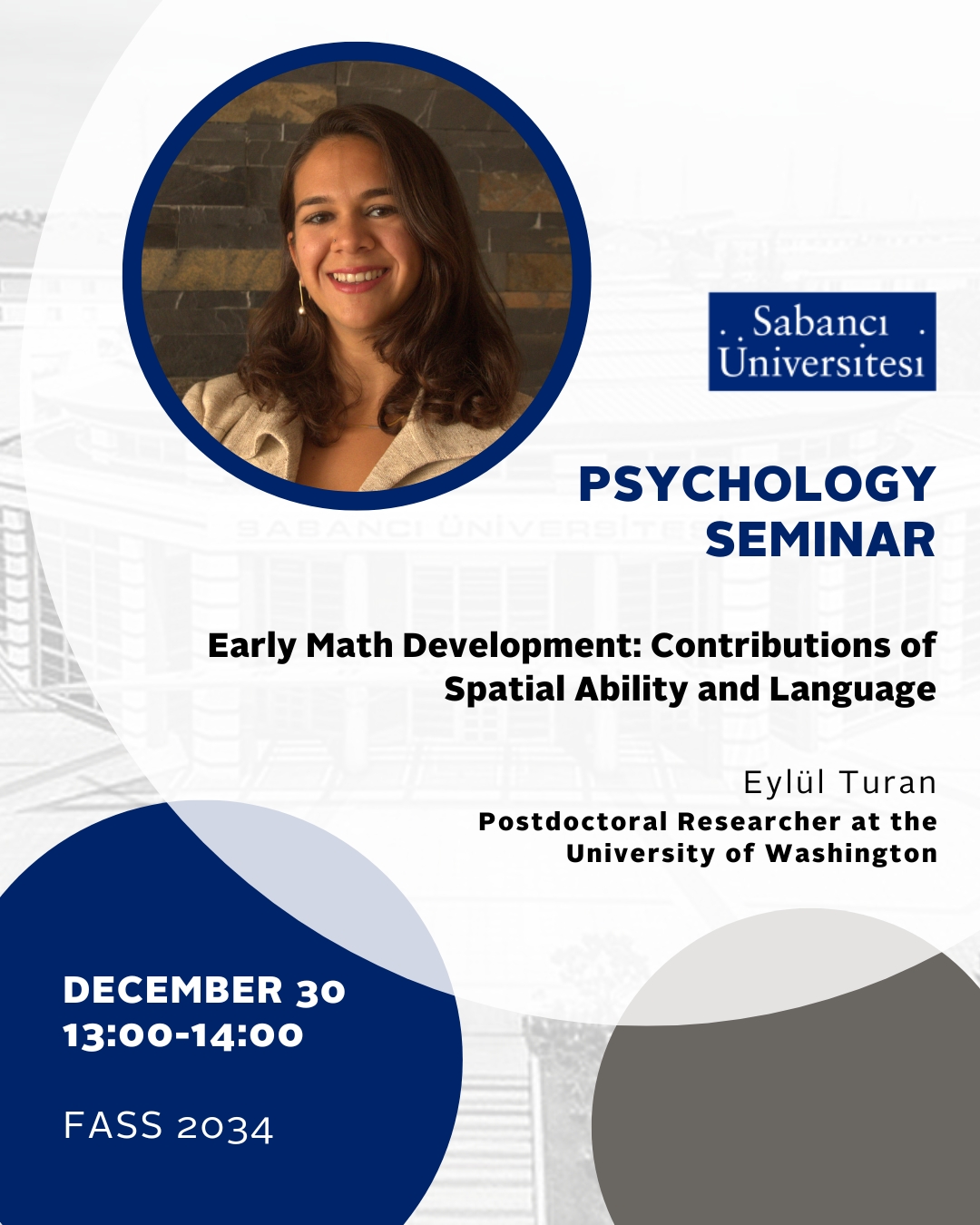
Abstract:
Mathematical competence is critical as it leads to a range of positive school and life outcomes such as entry into STEM fields, high socioeconomic levels, and even health and personal well-being. In particular, early mathematical abilities during the preschool are strong predictors for the variability observed in later mathematical skills. Hence, it is critical to understand factors contributing to the observed differences. Growing evidence highlights the role of spatial skills, i.e., children’s ability to reason about object locations, shapes, relations, and movements, in supporting early mathematical development. Additionally, early language skills have been shown to contribute to children’s mathematical abilities. In this talk, I will present my research examining how spatial skills and language collaboratively relate to early mathematical competence in preschoolers, using a range of methodological approaches. I will also discuss future research directions aimed at developing a more comprehensive understanding of the foundations of early mathematical learning.
Bio:
I am a second-year Postdoctoral Researcher at the University of Washington, working with Dr. Ariel Starr. I completed my PhD at KU Leuven under the supervision of Dr. Bert De Smedt, supported by an FWO Graduate Research Fellowship. During my PhD, I conducted a research visit at Purdue University, where I worked with Dr. David Purpura and Dr. Sarah Eason. I hold a BA in Psychology from Koç University and an MSc in Cognitive Neuroscience from the University of Amsterdam. The main goal of my research is to understand how spatial thinking contributes to mathematical development. I am especially interested in the roles of spatial language and relational reasoning in this process. Additionally, I examine how environmental factors, such as parent–child and teacher–child interactions, relate to these skills. To address these questions, I conduct studies with infants and children using behavioral and eye-tracking methods, and I employ cross-sectional, longitudinal, and intervention designs to uncover underlying mechanisms.