
Brown Bag Seminar by Mustafa Kutlay (University of London)
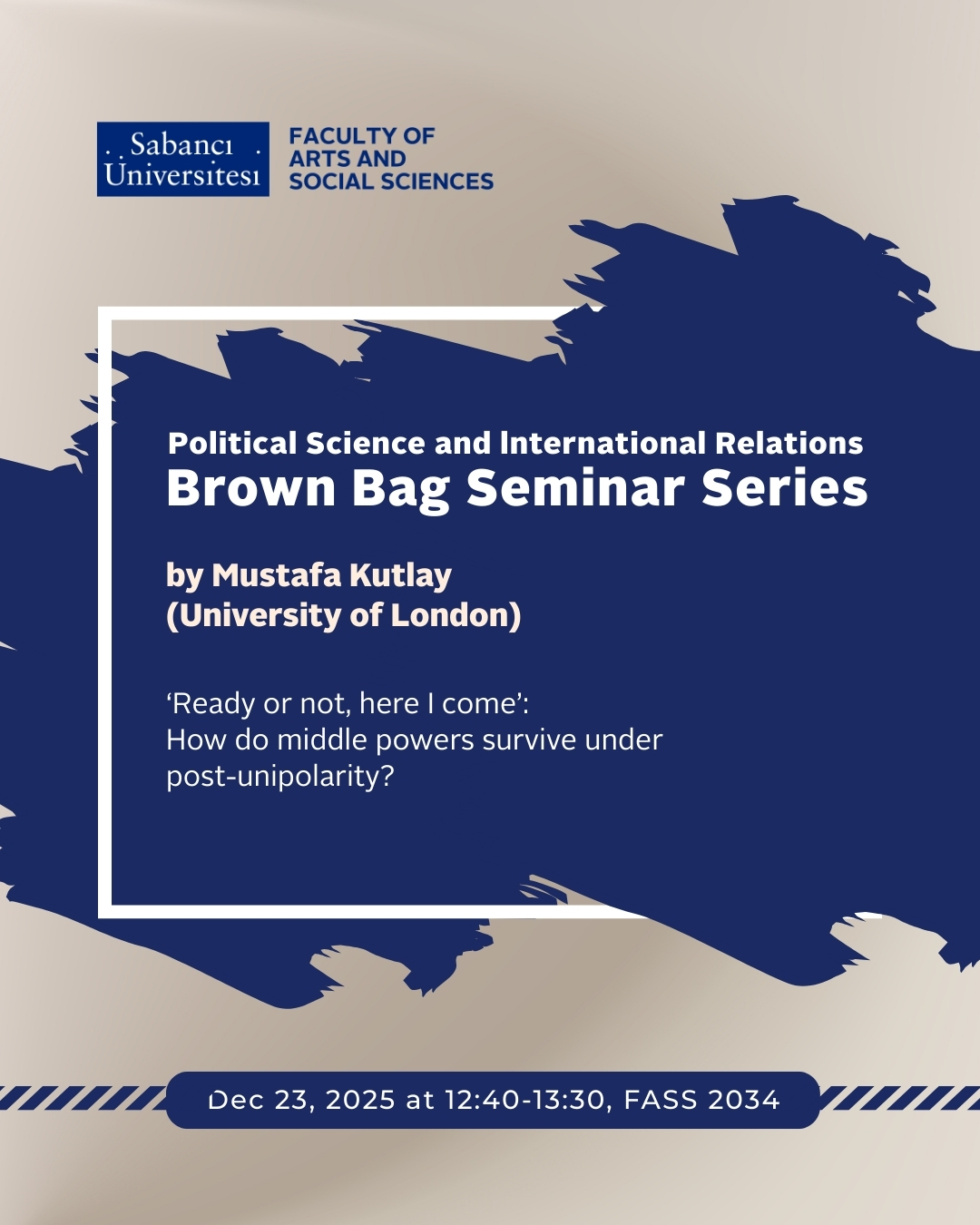
Abstract: How do middle powers navigate an uncertain international system characterised by great power competition and the weaponisation of economic interdependence? This paper aims to address this question in two steps. First, it offers a framework to analyse the existing international system. I argue that the current international system should be best conceptualised as post-unipolar. More precisely, it can be conceptualised as ‘porous bipolarity,’ which is qualitatively different from the Cold War bipolar environment. Porous bipolarity is characterised by a high level of interdependence among nations, along with ‘weaponised interdependence’ and increasing transactionalism. Second, the paper argues that the primary challenge for middle powers under porous bipolarity is not to pick sides but to manage multiple interdependencies. For middle powers, the main goal becomes acquiring strategic autonomy, rather than mere hedging or bandwagoning. I will primarily focus on the Turkish case to substantiate the paper’s key points.
Short bio: Mustafa Kutlay is a senior lecturer (associate professor) in the Department of International Politics at City St George’s, University of London. He is also a senior scholar at Istanbul Policy Center. His current research focuses on the Turkish political economy and foreign policy, institutions and development in the Global South, international/comparative political economy, and middle powers and the international order. His articles have appeared in International Affairs, Journal of Democracy, Foreign Affairs, Globalizations, Government & Opposition, Survival, Competition & Change, International Politics, Third World Quarterly, and The British Journal of Politics and International Relations, among others. His most recent book, Industrial Policy in Turkey: Rise, Retreat and Return, is published by Edinburgh University Press (co-authored with M. Toksoz and W. Hale).